LOC20:26
17:26 GMT
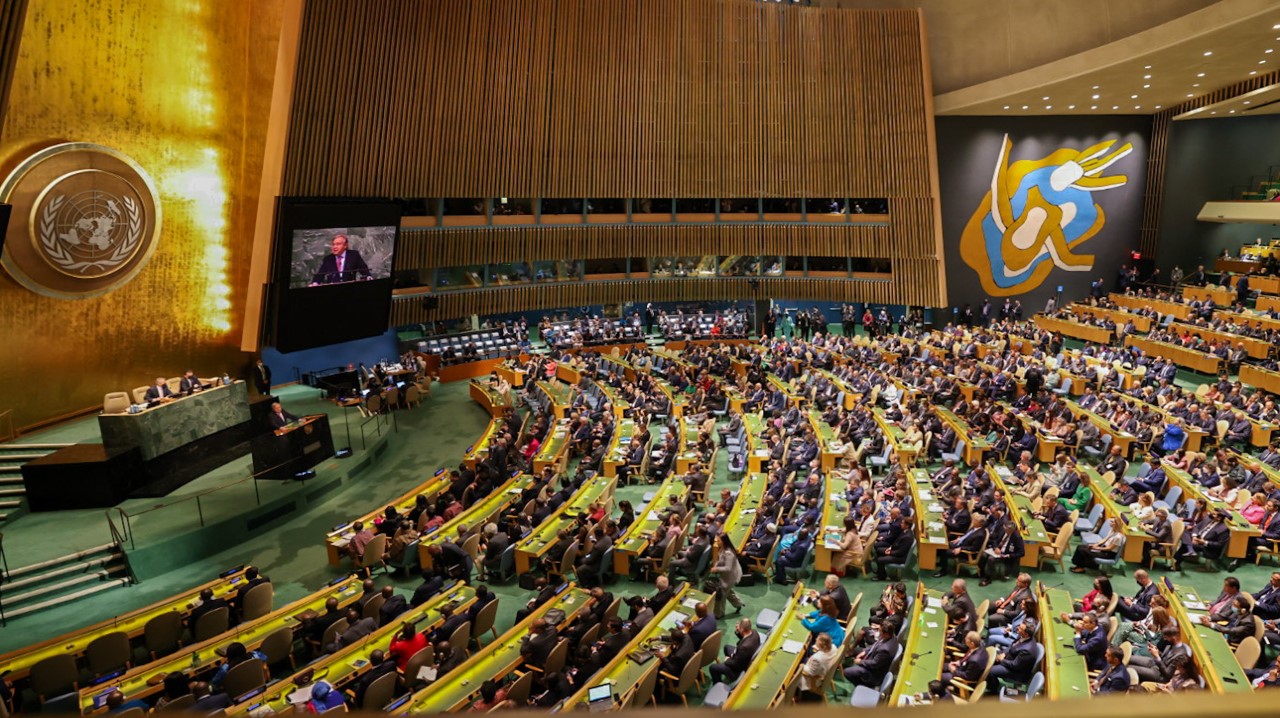 UN General Assembly 77th session kicks off
NEW YORK, Sept 20 (KUNA) -- UN Secretary General Antonio Guterres inaugurated on Tuesday the high-level debate as part of the 77th session of the General Assembly, in the presence of Representative of His Highness the Amir Sheikh Nawaf Al-Ahamd Al-Jaber Al-Sabah, His Highness the Prime Minister Sheikh Ahmad Nawaf Al-Jaber Al-Sabah.
In his inaugural speech, Guterres said, "Our world is in big trouble. Divides are growing deeper; inequalities are growing wider; challenges are spreading father, we need hope, we need action across the board."
He warned that the world might face a food crisis in the next year, indicating that the international community is not able, or has no desire, to face the major dramatic challenges while geopolitical divisions undermine the UN Security Council and international law.
Guterres lamented, "our world is in peril and paralyzed by political divides that were undermining the work of the Security Council, international law, trust and people's faith in democratic institutions, and all forms of international cooperation."
Along with the climate emergency and biodiversity loss, and the war in Ukraine, Guterres said of crises like the dire financial situation of developing countries and the fate of the Sustainable Development Goals (SDGs), "a forest of red flags across a host of new technologies", rising hate speech and "out of control" digital surveillance, "we don't have the beginning of a global architecture to deal with any of this."
On Afghanistan's economy, Guterres said "the economy is in ruins, over half of all Afghans face extreme levels of hunger, while human rights, particularly the rights of women and girls are being trampled."
"In Syria, violence and hardship still prevail. The list goes on. Meanwhile nuclear saber-rattling and threats to the safety of nuclear plants are adding to global instability.
The review conference of the Nuclear Non-Proliferation Treaty failed to reach consensus and a nuclear deal with Iran remains elusive," he stated.
"We are committed to make the most of every diplomatic tool for the pacific settlement of disputes, as set out in the United Nations Charter: negotiation, enquiry, mediation, conciliation, arbitration and judicial settlement.
"Women's leadership and participation must be front and center. And we must also prioritize prevention and peacebuilding," he said.
On climate change, the UN chief said, "Global greenhouse gas emissions need to be slashed by 45 percent by 2030 to have any hope of reaching net zero by 2050."
He went to say that "And yet emissions are going up at record levels - on course to a 14 percent increase this decade. We have a rendezvous with climate disaster. I recently saw it with my own eyes in Pakistan - where one-third of the country is submerged by a monsoon on steroids."
"We see it everywhere. Planet earth is a victim of scorched earth policies. The past year has brought us Europe's worst heatwave since the Middle Ages."
"We are seeing the threat of dangerous divisions between West and South. The risks to global peace and security are immense.
"We must keep working for peace in line with the United Nations Charter and international law. At the same time, conflicts and humanitarian crises are spreading - often far from the spotlight.
The funding gap for our Global Humanitarian Appeal stands at USD 32 billion - the widest ever," he elaborated.
"The climate crisis is a case study in moral and economic injustice. The G20 emits 80 percent of all greenhouse gas emissions. But the poorest and most vulnerable - those who contributed least to this crisis - are bearing its most brutal impacts.
"Meanwhile, the fossil fuel industry is feasting on hundreds of billions of dollars in subsidies and windfall profits while household budgets shrink and our planet burns.
He stressed the necessity for the world of getting rid of poverty.
"Developing countries need help to make this shift, including through international coalitions to support just energy transitions in key emerging economies.
"Second, helping countries adapt to worsening climate shocks. Resilience-building in developing countries is a smart investment - in reliable supply chains, regional stability and orderly migration," he mentioned.
He lauded Istanbul agreement regarding transferring Ukraine's grains via the Black Sea.
"In truth, it is multilateral diplomacy in action. The Black Sea Grain Initiative has opened the pathway for the safe navigation of dozens of ships filled with much needed food supplies," he pointed out.
He finally said, "It is essential to continue removing all remaining obstacles to the export of Russian fertilizers and their ingredients, including ammonia.
These products are not subject to sanctions - and we are making progress in eliminating indirect effects." (end)
asf.rj.hm