LOC14:30
11:30 GMT
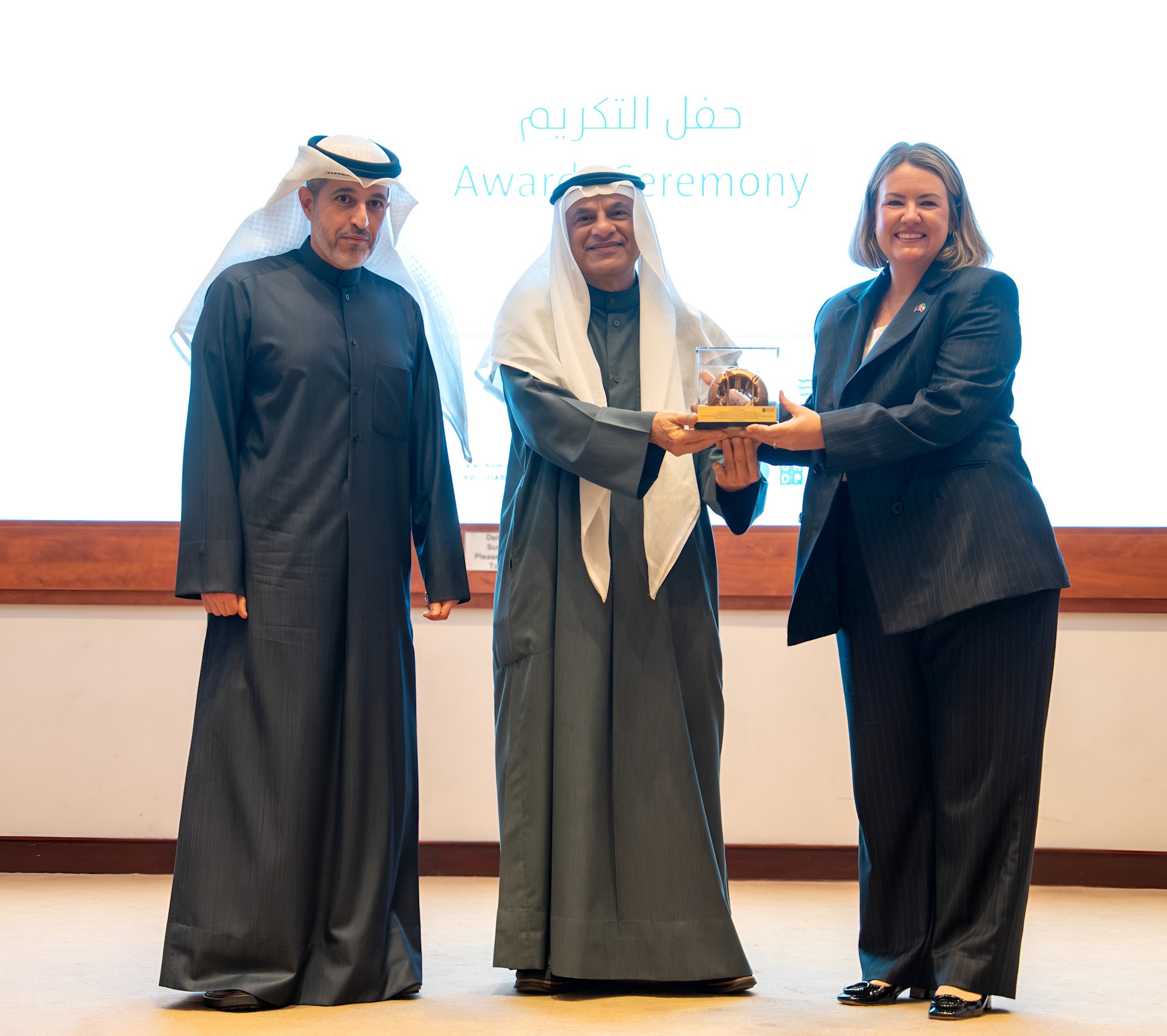 Minister of Higher Education honors Australian Ambassador to Kuwait
KUWAIT, Feb 2 (KUNA) -- Minister of Higher Education and Scientific Research Dr. Nader Al-Jallal on Monday said organizing the "Second International Conference on Successful Aquaculture and Biodiversity Conservation" reflects the Ministry's keenness, through Kuwait Institute for Scientific Research (KISR), to strengthen international partnerships.
In a statement to KUNA on the conference's opening, Al-Jallal said the event contributes effectively to achieving sustainable development goals and consolidating Kuwait's position as a regional hub for research and innovation in food security and environmental sustainability.
KISR Director General Dr. Faisal Al-Hamidan said in an opening speech that the conference is held under the theme "Toward Achieving Food Security and Resource Sustainability in the Gulf Region," with the participation of a select group of experts and researchers from brotherly and friendly countries to discuss latest practices in the vital field.
Al-Hamidan said the event comes at a time when the world faces mounting challenges related to food security, sustainability of natural resources and climate change impacts on ecosystems, making enhanced scientific cooperation and international expertise exchange an urgent necessity.
He noted Kuwait has placed environmental sustainability and food security among its top development priorities, stressing the marine sector is a key pillar given its role in providing food and supporting the national economy.
Al-Hamidan said the Gulf's marine environment has faced cumulative pressures in recent decades, including urban expansion, pollution and overfishing, leading to declining fish stocks and ecological imbalance, adding that aquaculture emerges as a "strategic and practical" solution to ease pressure on natural fisheries and support self-sufficiency.
He said KISR has a pioneering track record spanning more than five decades in marine research, achieving tangible results in farming high-value local species such as Sobaity, Hamour, Shaam and Zubaidi, as well as developing advanced techniques for farming Australian seabass.
In this regard, he highlighted Kuwait's regional leadership in developing Shaem aquaculture systems using recirculating aquaculture systems (RAS), and its global leadership in raising the species to commercial sizes using low-salinity water, a project supported by Kuwait Foundation for the Advancement of Sciences.
Al-Hamidan said aquaculture is increasingly viewed worldwide as an optimal solution to meet rising demand, noting it currently supplies around 56 percent of global market demand according to Food and Agriculture Organization (FAO) statistics, and is among the fastest-growing food industries.
He said the conference features broad participation by experts from Australia, Oman, the UAE, Qatar, Bahrain, India, Singapore, the Maldives, Thailand and Sweden to exchange expertise and discuss ways to develop the industry while ensuring environmental responsibility.
Al-Hamidan praised the active role of the Australian Embassy in Kuwait in supporting the conference, lauding its efforts to strengthen scientific partnership and facilitate technical expertise exchange between the two friendly countries to help develop aquaculture and transfer modern technologies.
He stressed KISR's commitment to supporting the "New Kuwait 2035" development plan by implementing initiatives to produce key marine species, developing integrated aquaculture systems (aquaponics) that rationalize water use, and encouraging private-sector investment to reduce reliance on imports.
He concluded by thanking supporting entities, including the Kuwait Foundation for the Advancement of Sciences, the Kuwait Fishermen Union and the private sector, expressing hope that the conference will yield practical recommendations that enhance food security and protect biodiversity in the region.
Australian Ambassador to Kuwait Melissa Kelly said in similar remarks that the two countries share deep and "close" bilateral relations as maritime nations, praising KISR's leading role in steering the transition toward a knowledge economy.
Kelly recalled historical links dating back to 1938, when Australian writer and sailor Alan Villiers documented the final days of traditional sailing-ship trade during his voyage aboard the Kuwaiti vessel "Bayan," recording in his renowned book "Sons of Sinbad" the courage of Kuwaitis and the realities of pearl diving, describing it as a reminder of early ties of friendship shaped by a shared love of the ocean.
She said food security has become a core pillar in the growing relationship between the two countries, noting that while the focus historically centered on trade in meat and grain, current cooperation in aquaculture represents a "natural and strategic evolution," expressing pride in Australian institutions' support for KISR's efforts in fish breeding.
Kelly highlighted the participation of leading Australian experts, including Ministry of Agriculture representative Dr. Donna Bennett to present sustainability policies, Prof. Dean Jerry to speak on the "golden barramundi," and Dr. Agus Sonarto of CSIRO to address innovation in strengthening aquaculture resilience.
She concluded by thanking KISR and conference organizers for their diligent efforts in preparing and organizing the scientific event, commending their role in reinforcing bridges of cooperation and scientific partnership between the two friendly countries.
(end)
oys.aa