Date : 27/02/2026
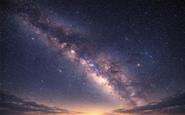
KUWAIT, Feb 27 (KUNA) -- For ancient Arab travelers, the sky was a faithful guide, and a glowing river of stars stretching across the night, inspired wonder and held a special place in their imagination.
The Milky Way is the galaxy that contains our solar system and Earth. In Arabic, it was named for its resemblance to scattered straw and was also called the "Mother of Stars" because of its vast number of stars, some brighter than others.
The galaxy belongs to the spiral galaxies, and its age is estimated at approximately 13.2 billion years, consisting of four main arms, one of which contains our solar system, all extending around a luminous center.
It has a diameter of 120,000 light-years and contains approximately two hundred billion stars, distributed among clouds of gas and dust within its spiral structure.
Two nearby galactic clouds, the Large and Small Magellanic Clouds, orbit the Milky Way and are visible to the naked eye from near the equator.
At the heart of this vast structure lies a colossal entity called a supermassive black hole, with a mass exceeding four million solar masses.
Nearby resides another supermassive black hole with a mass of approximately one hundred thousand solar masses.
In recent astronomical developments, a 2023 study revealed that the Milky Way's mass is four to five times less than previously thought.
The galaxy's mass was reassessed and estimated at approximately 200 billion times the mass of the Sun, five times less than previous estimates.
Last year, astronomers were able to reveal the turbulent dynamic environment surrounding the supermassive black hole at the galaxy's center, observing frequent flashes of light interspersed with powerful bursts of energy. (end)
star.ao