Date : 22/01/2026
By Iman Al-Kheraiji
DAVOS, Jan 22 (KUNA) -- The new "international framework" of the Peace Council entered into force immediately upon its signing on Thursday as part of the peace plan for the Gaza Strip announced by US President Donald Trump.
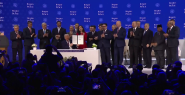
The signing ceremony of the Peace Council held during the annual meeting of the World Economic Forum in Davos was marked by a notable European absence following announcements by several European countries expressing dissatisfaction with the declared document.
While several countries welcomed the announcement and declared their intention to join, only a limited number of heads of state attending the Forum were present at the signing, including the President of Indonesia Prabowo Subianto and the President of Argentina Javier Milei, alongside heads of government and foreign ministers from several countries that announced their accession. The ceremony was notably absent of European Commission President Ursula von der Leyen.
Germany announced its refusal to join the Peace Board citing concerns that it could undermine the role of the United Nations.
The French president also said he would not sign the charter, warning that it poses a risk to the international order.
For her side, the UK foreign secretary Yvette Cooper announced on Thursday that her country would not sign the charter because of the presence of the Russian president.
The Italian Prime Minister Giorgia Meloni had signaled on Wednesday that Italy would not sign the document at this stage saying it does not comply with the Italian constitution.
Earlier this month the Swedish Prime Minister Ulf Kristersson confirmed that Sweden would not join the so-called "Peace Council" proposed by Trump in its current form.
For its part Switzerland the host country of the signing ceremony said it is conducting an "in-depth review" of the charterآ’s provisions and would not participate in the signing ceremony.
The ceremony also saw the absence of Belgium, Canada, Finland, Denmark and other European countries.
Trump first proposed the creation of the Peace Council in September as part of his announcement of the Gaza peace plan, with the initial aim of overseeing the reconstruction of the Strip and maintaining peace there.
However the charter, published in Media, does not limit the councilآ’s role to Gaza, granting it broader powers to address international conflicts worldwide and enhance stability in war-affected regions.
The councilآ’s expanded powers have been at the center of European criticism with some European officials viewing them as an unwarranted expansion from a body overseeing Gaza and its peace process into one dealing with global conflicts.
They accused President Trump of seeking to undermine the United Nations and replace it with a council under his control as stated by French President Emmanuel Macron during his address in Davos.
In his opening remarks earlier today at the signing ceremony President Trump said the Peace Council would work "in coordination with the United Nations," stressing that the Gaza plan "was unanimously adopted by the UN Security Council" and that the current phase focuses on the strict maintenance of the ceasefire and ensuring the flow of humanitarian aid.
For his part, US Secretary of State Marco Rubio said the council is primarily concerned with the situation in Gaza and the future of the Strip and the region, adding that if the council "could serve as a model for other conflict-ridden regions around the world."
The head of the National Committee for the Administration of the Gaza Strip Ali Abdel Hamid Shaath said that "it is his responsibility to turn this historic moment into an opportunity to secure a future for the Stripآ’s residents," announcing the opening of the Rafah crossing in both directions next week. (end)
imk.hb