Date : 09/01/2026
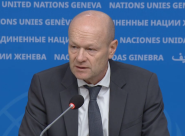
GENEVA, Jan 9 (KUNA) -- United Nations agencies warned Friday of Sudan's continued war risks plunging the country deeper into a severe humanitarian crisis amid shrinking funding, expanding displacement, worsening living and health conditions, and confirmed famine in several areas.
This came during a joint press briefing in Geneva by the UN Office for the Coordination of Humanitarian Affairs (OCHA) and the UN Children's Fund (UNICEF) held to mark the 1,000th day since the outbreak of the war on the 9th of January 2023.
OCHA Spokesperson Jens Laerke said that nearly 34 million people in Sudan now require humanitarian assistance, describing the scale of suffering as "staggering", adding that the entire region suffers from the spillover of the crisis.
He reiterated that Sudan has become the largest displacement crisis in the world with 9.3 million people displaced internally and more than 4.3 million forced to flee across borders, while population movements are being recorded in (Khartoum) where people are returning to a capital devastated by war and littered with explosive hazards.
He warned that continued fighting on multiple fronts particularly in (Kordofan) and (Darfur) has severely restricted access to food health care farms and markets. Sieges have cut off the towns of (Kadugli) and (Dilling), while in (Darfur) fighting on the ground and aerial attacks persist.
He added that more than 21 million people are estimated to be acutely food insecure with famine confirmed in (El Fasher) and (Kadugli) and at least 20 other areas at risk.
Laerke also mentioned the horrifying reports of serious violations of international humanitarian law including alleged mass killings during the Rapid Support Forces' takeover of (El Fasher) in late October.
He said the women are bearing the heaviest burden of the crisis, saying that data show that female-headed households are now three times more likely to be food insecure than those led by men, with hunger increasingly taking on a gendered dimension.
He further noted that cuts in financial support have forced a sharp prioritization of the 2026 Humanitarian Needs and Response Plan, while nearly 34 million people need assistance partners aim to reach only about 20 million due to funding constraints.
The plan requires 2.9 billion dollars, around 70 percent of last year's appeal reflecting funding realities rather than reduced needs.
For his part, UNICEF spokesperson Ricardo Pires said "Sudan has become one of the most devastating humanitarian crises in the world with more than 33 million people-two-thirds of the population-needing urgent assistance half of them children."
Pires added that more than five million children have been forced from their homes the equivalent of 5,000 children displaced every single day since the conflict began many of them repeatedly.
"Children continue to be killed and injured including reports this week of eight children killed in an attack in (Al-Obeid) North (Kordofan)," he warned.
He also warned that malnutrition has reached alarming levels particularly in (North Darfur), saying that nearly 85,000 children were treated for severe acute malnutrition in less than a year an average of one child every six minutes.
He added that measles and other vaccine-preventable diseases are resurging as immunization coverage has fallen below 50 percent amid the collapse of the health system.
Pires also highlighted the use of sexual violence as a weapon of war placing millions of children at risk, with survivors including children as young as one year old.
Both OCHA and UNICEF renewed their call for an immediate end to the fighting adherence to international humanitarian law protection of civilians and aid workers and a renewed push for funding. (end)
imk.mt