Date : 14/12/2025
KUWAIT, Dec 14 (KUNA) -- An Amiri decree published recently on combating narcotics and psychotropic substances, which comes into effect tomorrow, Monday, marks a pivotal turning point in the nation's legislative history.
Decree No. (159/2025) establishes a significant and impactful legal framework in the state's comprehensive war against drug traffickers and in saving their victims.
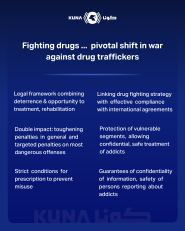
The 84-article law reflects the country's balanced philosophy, combining strict deterrence against criminal networks through the imposition of the harshest penalties, yet with humanitarian opportunities by opening the door for confidential and safe treatment for addiction victims.
The law merges the previous narcotics and psychotropic substances laws into a unified framework that provides multiple benefits, most notably standardizing concepts and terminology, and unifying criminal, penalty and procedural rules to facilitate implementation.
The precise definitions in the law's opening articles expand criminalization to cover all forms of illicit dealings, including non-cash methods such as bartering, or the provision of any service or benefit, thus strengthening the legislative approach.
The law enhances deterrence through two parallel tracks: comprehensive stiffening of penalties for all drug-related crimes, and targeted penalties for the most dangerous offenses, including the death penalty and life imprisonment, along with major fines for crimes such as smuggling, trafficking, manufacturing and cultivation, aimed at uprooting foundations of these criminal activities.
The law also expands protections for vulnerable groups.
Article 44 classifies a perpetrator's use of a minor, a mentally ill person, or someone under their care or supervision in committing the crime as an aggravating circumstance warranting the death penalty in trafficking and distribution cases.
The humanitarian and rights-based dimensions of the law are evident in Article 61, which stipulates that no criminal case shall be filed against an addict who voluntarily turns himself or herself in to an addiction center seeking treatment and rehabilitation, provided this occurs before any complaint or request for prosecution is filed.
The law gives paramount importance to protecting confidentiality and personal safety for individuals involved, whether whistleblowers or patients, boosting trust and encouraging help-seeking without fear of stigma or exposure.
Article 56 states that anyone who unlawfully discloses information related to reports and treatment of addicts, or details of individuals admitted to rehabilitation or addiction treatment centers, or the test results specified in Article 66, shall be punished with imprisonment of up to two years, a fine of up to KD 10,000, or one of the penalties.
The law also promotes reporting for treatment purposes.
Article 62 allows a spouse or a relative up to the third degree to report an addict for treatment, ensuring full confidentiality for the reporter. The reported individual shall be admitted to a rehabilitation center for a specified period and may be released early upon recovery.
Article Three establishes two distinct treatment structures: rehabilitation centers and addiction treatment centers.
Article Four authorizes the Ministry of Interior to establish correctional and rehabilitation centers for prison sentences in cases of possession for personal use. In these facilities, convicts must undergo medical treatment, rehabilitation, training and family/social reintegration programs.
Balancing punitive deterrence with rehabilitative treatment relates to Articles 63 and 64, which grant the Public Prosecution and the courts the authority to order admission into a rehabilitation center instead of filing criminal charges or imposing a sentence on individuals who commit offenses related to consumption, possession, import, smuggling, purchase, production or manufacturing of narcotics for personal use.
The creation of the Supreme Council for Combating Narcotics and Psychotropic Substances further reinforces anti-drug efforts through to a comprehensive national strategy and effective compliance with relevant international treaties. The Council will be responsible for developing a national strategy and planning awareness, prevention and treatment initiatives.
The law also sets strict requirements for prescribing and dispensing narcotics, as outlined in Articles 20, 22 and 24, strengthening regulatory oversight in medical practice to prevent leakage and misuse of prescriptions.
The First Deputy Prime Minister and Minister of Interior, Sheikh Fahad Yusuf Al-Sabah, affirmed in a statement following the issuance of the decree that the law marks a new era of legislative rigor.
Sheikh Fahad noted that recent years have witnessed the seizure of large quantities of narcotics and psychotropic substances and the thwarting of multiple smuggling attempts.
He stressed that the new law enhances the ability of security agencies to impose deterrence and tighten the grip on criminal networks through the strongest punitive framework the country has ever witnessed.
The National Human Rights Bureau stated that the law represents a significant legislative step that strengthens the national framework for protecting society and safeguarding fundamental rights, in addition to fulfilling key international requirements and ensuring comprehensive protection standards.
In a coordinated effort, state institutions launched awareness campaigns ahead of the law's enforcement to educate the public about its provisions and raise societal awareness about the dangers of drugs and limit their spread.
The Ministry of Interior launched the national campaign "We Protect the Nation," implemented in two phases: the first lasting two weeks before enforcement, and the second consisting of a year-round awareness campaign on the risks of narcotics and psychotropic substances.
The Ministry also opened the first field exhibition for the national awareness campaign at The Avenues Mall, with the participation of Kuwait Bar Society and the Ministry of Health, featuring interactive displays, awareness videos and educational materials for visitors.
In addition, the Public Prosecution launched in early December a proactive media campaign through its official platforms, stating that this initiative "is not merely an informational measure but part of its responsibility and firm message: the coming phase will be of firmness and precise enforcement from the very first moment the law is born."
The Cabinet had approved the draft decree on 28 October, reflecting the government's firm will to protect human and social security and to align Kuwait with best international practices in combating narcotics. (end)
star.eng