Date : 12/11/2025
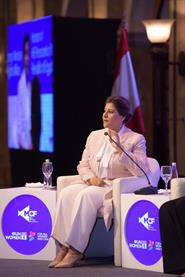
BEIRUT, Nov 12 (KUNA) -- Kuwait's Assistant Minister of Foreign Affairs for Human Rights Sheikha Jawaher Ibrahim Al-Duaij Al-Sabah stated Wednesday that Kuwait has made great strides in empowering women across a wide array of sectors over the past 60 years.
Sheikha Jawaher made this remark during her participation in the opening session of the 12th Women on the Front Lines Conference, organized by the Beirut-based May Chidiac Foundation in collaboration with the UN Women and under the patronage and in the presence of Prime Minister of Lebanon Nawaf Salam.
The State of Kuwait has enacted a heap of important laws to empower women, enshrine their rights and enhance their role in society, Sheikh Jawaher said.
She stressed that women enjoy unlimited support from the Kuwaiti leadership, especially for appointing them in top state posts.
The State of Kuwait, with the support of the political leadership, has recently introduced a number of legislative reforms to improve women rights, the most notably the abolishment of Article 153 of the Penal Code concerning honor killings, she clarified.
The Assistant Minister of Foreign Affairs added that Kuwait has also raised the legal age of marriage for girls and is working on a number of other measures to boost women's rights.
She boasted that Kuwaiti women's representation in science and technology sectors is estimated at 70 percent, the highest worldwide.
Moreover, presidents of the country's two universities are women, she said, adding that women are also well represented in the workforces and leadership of the oil sector, banks, and financial institutions, she said.
Sheikha Jawaher pointed out that there are approximately 980 laws and legislations in Kuwait pertaining to women's issues and human rights in general.
"Ten percent of these laws are currently under review to further enhance human rights and women's rights in the country," she unveiled.
For his part, Lebanese Prime Minister Nawaf Salam stated that empowering women is a fundamental condition for Lebanon's progress and the creation of strong state institutions.
"Women were at the forefront of student and civil movements after the war, defending dignity, justice, and citizenship," he said.
He regretted that women parliamentary representation in Lebanon "remains very low, less than 6.3 percent, compared to a global average of 26 percent".
He pointed out that the Lebanese government includes five female ministers.
He underlined the need for the adoption of a legislation that obligate electoral lists to include a certain percentage of women candidates.
Salam stated that women's participation in the labor market does not exceed 27.5 percent and that their ownership of companies is less than 10 percent.
He also emphasized the need to protect women from domestic and digital violence, which affects more than 80 percent of them.
The "Women on the Front Lines" (WOFL) conference addressed several key topics, most notably the revival of women's roles in Lebanon and the Arab world, continuing a tradition of celebrating inspiring female figures who have overcome challenges and made tangible impacts across politics, diplomacy, business, technology, and media.
Since 2013 in Lebanon and 2016 in Jordan, the Women on the Front Lines (WOFL) conference has been a testament to the unwavering commitment to driving positive change to women status in the Arab World. WOFL provides a platform for powerful stories, bold ideas, and the celebration of women transforming their communities. (end)
fz.ibi