التاريخ : 26/04/2025
(Report)
KUWAIT, April 26 (KUNA) -- Kuwait is making steady strides toward reinforcing the rule of law and entrenching the principles of transparency and justice through a series of legislative amendments and decisions under a comprehensive strategic vision.
This aims to embed the values of integrity and provide a fair and transparent legal environment that meets the challenges of the times and fulfills citizens' aspirations.
The pieces of legislation recently adopted by the Cabinet to modernize the country's legal infrastructure mark a qualitative addition to the path of Kuwaiti justice, protecting public funds, combating corruption, keeping pace with rapid technological developments, and expanding the scope of digital judicial services.
In this context, the Cabinet approved last Tuesday a draft decree-law to amend certain provisions of the Penal Code (Law No. 16 of 1960), aimed at protecting public rights, enhancing deterrence, and addressing legal gaps exposed in practical implementation.
The amendments address the decline in caution among individuals leading to injuries and fatalities by increasing financial penalties for manslaughter and accidental injury, and by adding two new articles introducing aggravated circumstances for both offenses when tied to their material elements.
A new provision was also introduced to protect the credit system in the country from debtors who misrepresent their financial position as insolvent. This includes criminal protection of the debtor's assets transferred to others aware of the debts, aimed at preventing evasion of repayment.
The draft decree-law amending the Code of Criminal Procedure also tackled issues affecting justice procedures, allowing (Article 188) to be modified to permit electronic notifications of verdicts alongside traditional methods, speeding up verdict announcements.
The decree enhances the guarantees for the convicted to be informed of rulings, helps reduce litigation delays, and limits the statute of limitations for in absentia judgments due to notification challenges.
Additionally, the amendment of (Article 230) addresses the accumulation and difficulty in collecting criminal fines, allowing the Public Prosecution to directly collect them from the convicted or deduct up to a quarter of their salary, with installment plans of up to five years in consideration of humanitarian and financial conditions.
This new decree protects public funds, preserves state rights, and enhances the execution of judgments, preventing offenders from escaping punishment, while balancing justice with the rights of individuals and the community.
In response to practical cases where solvent debtors evade measures against them, the Cabinet issued a draft law to amend (Article 5) of Law No. 71 of 2020 on bankruptcy. It reinstates the power to detain debtors who stubbornly avoid repayment.
The new law strengthens the General Department of Enforcement's powers against defaulting debtors, granting it authority to take decisive actions and request a financial disclosure of assets including properties, movable assets, bank accounts, and the identities of asset transferees.
The Cabinet also issued a draft decree-law amending the Civil and Commercial Procedure Law (Decree No. 38 of 1980), enabling the Enforcement Department to notify credit reporting agencies about default events, to reflect the debtor's creditworthiness when dealing with legal entities.
In parallel, Kuwait enhanced the powers of the Anti-Corruption Authority (Nazaha) through a draft decree-law amending Law No. 2 of 2016, which governs the establishment of Nazaha and financial disclosure regulations.
These amendments aim to advance the legal framework for combating corruption. They expanded the scope of corruption crimes to include embezzlement of cooperative society funds, ensuring shareholder protection and enhanced oversight.
New provisions require reasoning for decisions to dismiss reports, boosting transparency and oversight, and enable the use of electronic tools for submitting financial disclosures-especially beneficial for diplomatic and consular staff abroad. Procedural protections for Nazaha employees were also introduced.
Decree-Law No. 94 of 2024 amending Decree-Law No. 20 of 1981 defined a value threshold for cases before the Court of Cassation in administrative matters, ensuring the court focuses on significant disputes and its role in unifying legal principles and ensuring proper application of the law.
To improve the justice process and equality among litigants, Decree-Law No. 104 of 2024 amended the Criminal Procedure Law, extending the appeal period to 30 days. This change addresses the practical delays in delivering verdict copies to parties.
The law also added a new article (22 bis), permitting modern communication methods for summoning defendants in criminal cases, similar to those approved in civil and commercial procedure laws.
To enhance transparency in real estate transactions, the Minister of Justice, Counselor Nasser Al-Sumait, issued Decision No. 194 of 2025 regulating payments in contracts and official debt/rental documents issued by the Ministry of Justice.
This decision mandates proof of payment via bank transfer or certified check to combat money laundering and limit fictitious mortgages and debt declarations, while closing legal loopholes used for illicit transactions.
The decision helps safeguard the real estate market from financial manipulation, increases transparency, protects buyers and sellers from fraud, and enhances financial oversight and anti-money laundering efforts in real estate.
As part of Kuwait's reform and rehabilitation efforts, the decision to reduce life imprisonment to 20 years was issued by the Acting Prime Minister, Sheikh Fahad Yusuf Saud Al-Sabah, in line with political leadership's directives. The goal is to balance punishment with justice and allow inmates a chance to reintegrate into society.
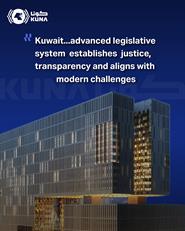
Kuwait also inaugurated the new Palace of Justice building in early February, representing a modern leap that supports a technologically advanced judicial environment and full digital transformation in litigation.
Following the political leadership's directives, the Ministry of Justice has laid out a set of strategic goals to strengthen the justice system-reviewing existing legislation, simplifying procedures, reducing case resolution times, expanding digital services to enhance access to justice, and reinforcing transparency and oversight to ensure judicial independence and integrity.
The ministry is also working on legislative amendments to fully digitize the judiciary, speed up case processing, improve access to legal services, and reduce case backlogs and delays. (end)
star.bb