التاريخ : 19/01/2023
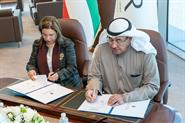
KUWAIT, Jan 19 (KUNA) -- Kuwait Institute for Scientific Research (KISR) signed an agreement with the UN Human Settlements Program (UN-Habitat) to finance the adaptation and resilience project for cross-border sand and dust storms coming from southern Iraq, and address the dust problem affecting Kuwait and Gulf states.
KISR's Director General Dr. Manea Al-Sudairawi said in a statement on Thursday that the project will be implemented in two areas in the south of Iraqi territory, with an area of 8,212 square kilometers, as they are major sources of dust storms.
Both regions were identified after scientific studies carried out by KISR were published in scientific journals, through which he determined the locations and number of dust storms that reach Kuwait from 2020 until the end of 2022, he added.
The project aims to identify the causes of sand and dust storms from the climatic and geological aspects, protect and increase the skills of adaptation and resilience in storm areas and absorb their negative effects in order to reduce their occurrence while achieving a set of sustainable development goals and produce measurement mechanisms and indicators to mitigate the effects of storms, he stated.
The annual losses resulting from sand and dust storms were estimated at KD 190 million, while the project, which will be implemented through the UN program at a value of KD 4 million, will target specific areas located 250 kilometers north of the Kuwaiti border, he mentioned.
He referred to the direct impact of those areas, which amounts to 40 percent of the total storms that Kuwait, southern Iraq and the eastern region of Saudi Arabia, Qatar, Bahrain and parts of UAE are exposed to.
Dust storms caused the closure of ports and roads, causing huge economic losses, in addition to health and environmental damage, as that cross-border sandstorms that lead to the accumulation of dust increased from 60 tons per square kilometer in 2006 to over 500 tons per square kilometer in 2022, he indicated.
The project will work to stabilize the soil in the regions of northern Iraq and thus reduce cross-border dust, Dr. Al-Sudairawi stated, noting that building barriers inside the country without addressing the main source will not suffice, especially since the path of dust starts from those areas, passing through Kuwait, to Qatar and UAE.
A groundbreaking infrastructure will be designed to rehabilitate areas affected by sand and dust storms and mitigate their harmful effects through several methods, he said.
The project will be carried out through the use of heavy machinery such as excavators and soil dumpers to place a heavy clay layer as the consistency of the clay layer when it rains gives an opportunity for natural plant growth and the cultivation of drought-resistant fungal trees in windbreaks to help stabilize the soil and increase plant density, he mentioned.
In a similar statement, Head of Office at UN-Habitat for Arab Gulf States Dr. Ameera Al-Hassan said that this agreement was a result of the deal signed with the Kuwait Fund for Arab Economic Development (KFAED), which aims to treat dust from its sources.
Dr. Al-Hassan underlined the significance of the agreement, which addresses the problem from its sources in a sound scientific manner that will result in improving the public health of the population and dusty areas, as well as improving the economies of the affected countries.
KFAED signed on October 27 with UN-Habitat a grant agreement worth KD 4 million (about USD 13.2 million) to finance the this project for cross-border sand and dust storms between Iraq and Kuwait to reduce the chances of these storms. (end)
ays.lr