LOC10:53
07:53 GMT
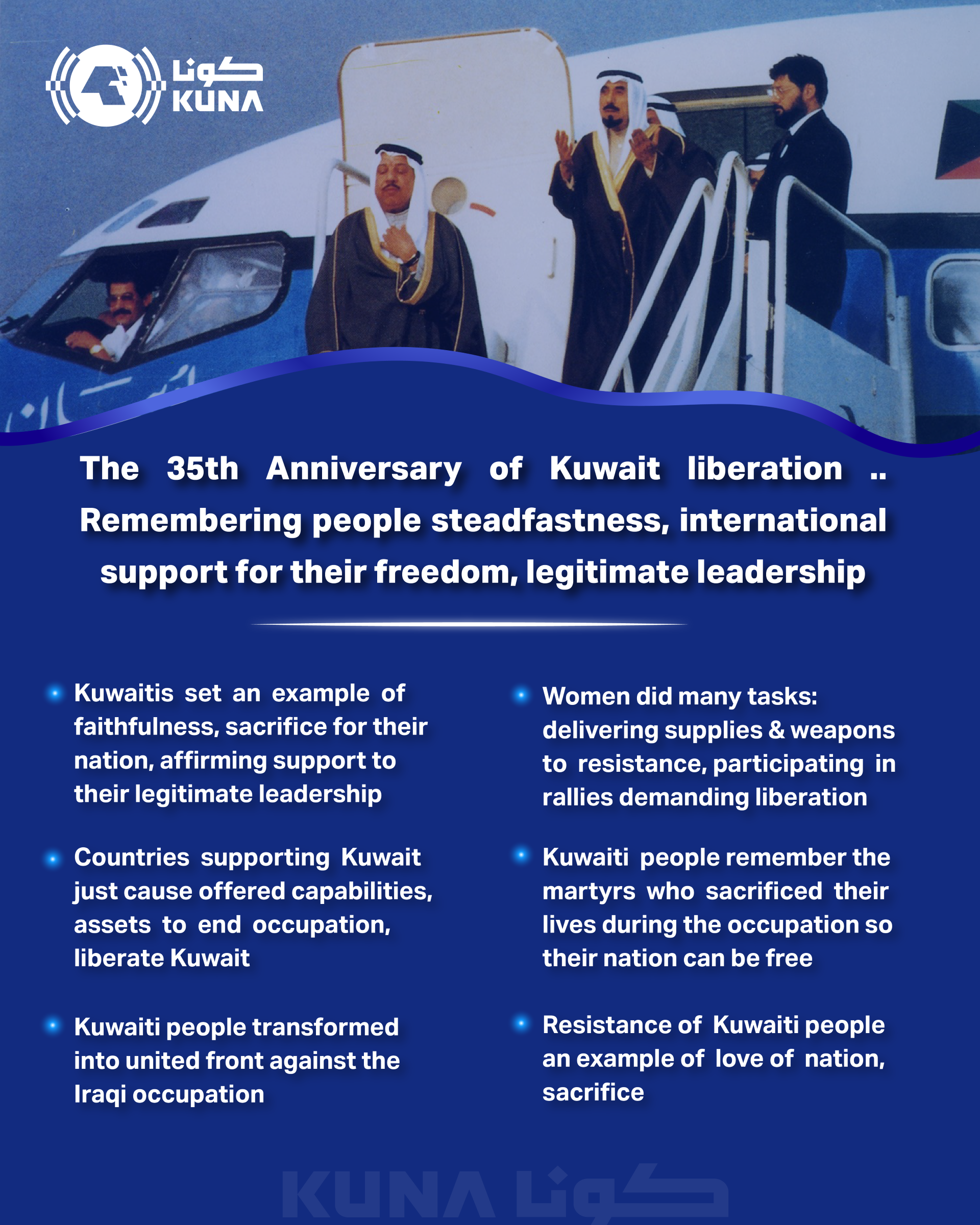
KUWAIT, Feb 25 (KUNA) -- Kuwait marks Thursday the 35th anniversary of its liberation, recalling with pride the steadfastness of its people during the Iraqi invasion on August 2, 1990, and international support for its freedom and legitimate leadership.
Despite the hardship endured, Kuwaitis demonstrated loyalty and sacrifice, rejecting aggression and uniting behind their legitimate leadership to defend sovereignty, freedom and independence.
During the occupation, Kuwaitis formed a unified front of resistance, with some taking up arms while others supported the popular resistance. Women played vital roles, including delivering supplies and participating in demonstrations.
Kuwaitis remember their martyrs who gave their lives so the nation could regain its freedom, and the leadership's tireless efforts to rally international backing for Kuwait's legitimate rights until liberation was achieved.
They recall the address of the late Amir Sheikh Jaber Al-Ahmad Al-Jaber Al-Sabah before the United Nations, in which he conveyed the message of a peace-loving people whose security had been violated.
Kuwaitis also remember the efforts of the late Amir Sheikh Saad Al-Abdullah Al-Salem Al-Sabah, then Crown Prince, in organizing the government in exile and supporting citizens and the resistance.
The late Amir Sheikh Sabah Al-Ahmad Al-Jaber Al-Sabah, then foreign minister, played a key diplomatic role in mobilizing Arab and international support for Kuwait's legitimacy.
The late Amir Sheikh Sabah Al-Ahmad Al-Jaber Al-Sabah, then serving as foreign minister, played a pivotal role in mobilizing Arab and international diplomatic support for Kuwait's legitimacy, drawing on his extensive experience, which helped secure global backing.
Kuwaitis express gratitude to the late Saudi monarch King Fahd bin Abdulaziz Al-Saud for hosting Kuwait's leadership and people and providing political, financial and military support.
Gulf Cooperation Council states led early political and diplomatic efforts rejecting the invasion, contributing to UN Security Council resolutions, starting with Resolution 660 demanding Iraq's immediate withdrawal.
Resolution 678, issued on November 29, 1990, set January 15, 1991, as a deadline for Iraqi withdrawal, authorizing the use of all necessary means to implement prior resolutions.
On January 12, 1991, the US Congress authorized President George H. W. Bush to use armed force to expel Iraqi troops.
Coalition forces launched the ground offensive on February 24, 1991. Iraqi forces began withdrawing on February 26, and Kuwait's liberation was declared the following day after 100 hours of ground operations.
Kuwait's liberation remains a lasting testament to national unity, resilience and unwavering loyalty to its leadership. (end)
rb.aai