LOC10:57
07:57 GMT
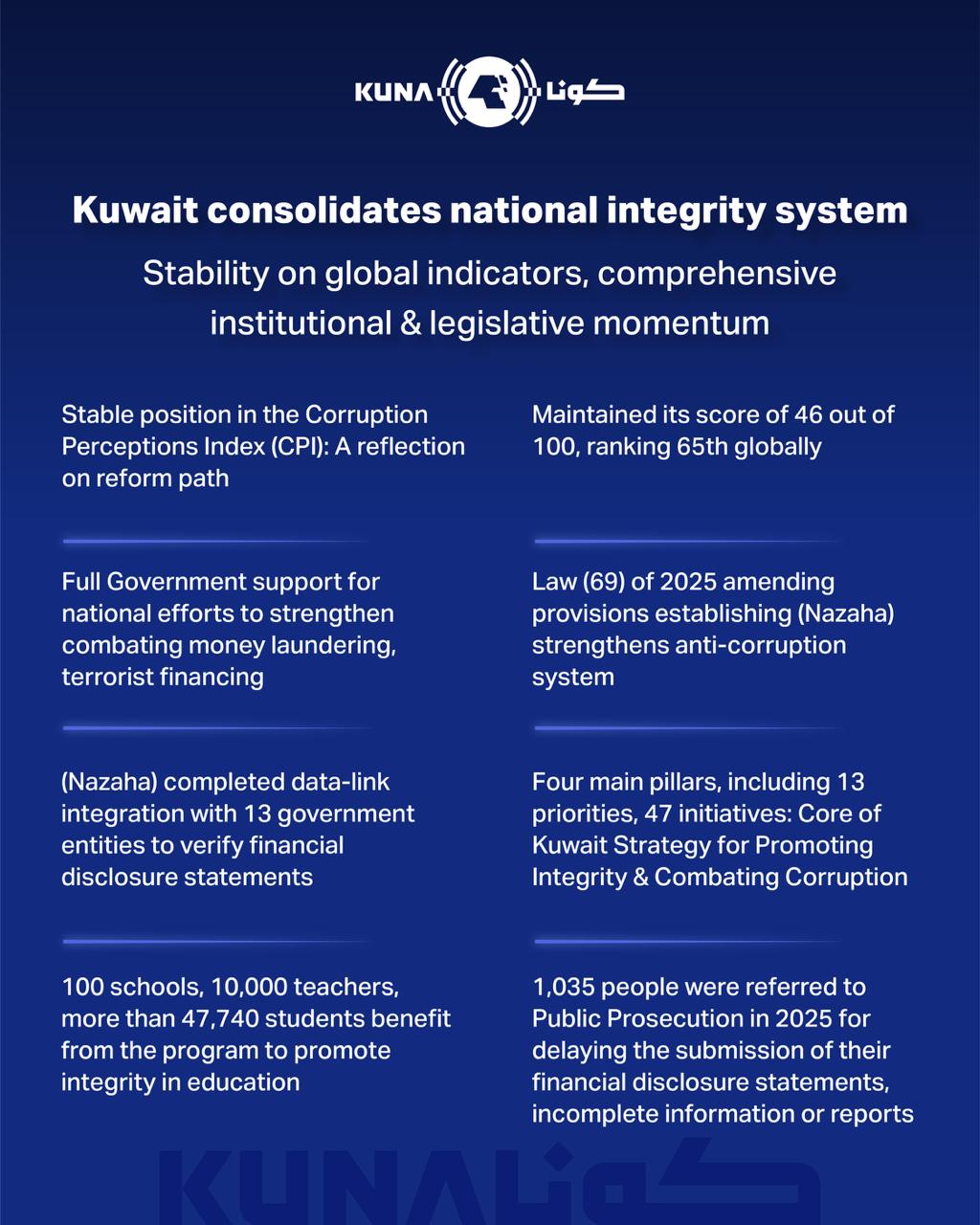
KUWAIT, Feb 23 (KUNA) -- State of Kuwait is steadily advancing foundations of its national integrity system, relying on integrated institutional and legislative efforts that have successfully aligned international standards with national priorities.
Legal amendments have worked to close legislative gaps, alongside strict oversight measures covering various sectors.
Kuwait's position in the 2025 Corruption Perceptions Index (CPI) reflects this reform path, maintaining its score of 46 out of 100, ranking 65th globally out of 182 countries and territories, confirming the resilience of its system amid declines in the global average.
The Public Authority for Anti-Corruption (Nazaha) affirmed that Kuwait's stable position in the international ranking came despite the expanded scope of countries included in the index and a sharp global decline, with most countries scoring below the global average, which reached its lowest level in more than a decade.
Nazaha stated in a press release marking the release of the CPI report the concerning global downward trend highlights the importance of Kuwait maintaining performance above the global average and working toward gradual and sustainable improvement in future.
The year 2025 witnessed several achievements that positively strengthened transparency, accountability, institutional culture across state institutions, and raised levels of compliance and awareness of anti-corruption prevention.
On the legislative front, significant reforms were enacted through the approval of Law No. (69) of 2025 amending provisions of the law establishing Nazaha. The step aims to strengthen the transparency and integrity framework, support national anti-corruption efforts and address gaps that emerged during the practical application of the law.
The amendment expands the scope of those subjected to the law, including embezzlement crimes involving cooperative societies. It also enhances Nazaha's powers to enable it perform its role more effectively, particularly in evidence collection, hearing testimonies, and detecting financial and administrative corruption violations.
The amendments further require carefully-taken decisions when closing complaints, making it mandatory for such decisions to be issued by the Board of Directors of Nazaha with stated justifications, thereby enhancing transparency and oversight.
The new legislation provides an additional legal safeguard to ensure that no corruption suspicion escapes judicial oversight, while also allowing settlements in cases involving delays in submitting financial disclosure statements, achieving a balance between deterrence and flexibility in application.
In parallel, Nazaha completed a guideline for the mechanism and content of annual reports for government entities, serving as a roadmap to align periodic reports of public institutions with the goals of the "Kuwait 2035" vision.
The guideline aims to establish a unified practical framework ensuring that reports reflect actual government performance, emphasizing strict standards such as clear language, data accuracy and issuance within the first quarter of each fiscal year, enabling decision-makers to take corrective or developmental actions based on reliable data.
Nazaha also completed data-link integration with 13 government entities to obtain the necessary information to verify the accuracy of financial disclosure statements. In 2025, it referred 1,035 individuals to the Public Prosecution, including those who delayed submitting financial disclosures, provided incomplete information, or were subject to corruption complaints.
In promoting integrity in education, the "Banki" program made promising progress in 2025, expanding to more than 100 public and private schools across Kuwait. The program involves over 10,000 teachers and benefits more than 47,740 students.
The program, the first of its kind in Kuwait, aimed at enhancing financial literacy and ethical values among school students through a partnership between the public and private sectors.
These efforts were crowned by the Kuwait Strategy for Promoting Integrity and Combating Corruption, winning the 2025 Arab Government Excellence Award as the best Arab initiative for developing government action plan.
The strategy is based on four main pillars and objectives, encompassing 13 priorities distributed across 47 initiatives, each built on selected activities, standards and indicators.
At the executive level, various ministries strengthened their anti-corruption and justice measures by issuing regulatory decisions and forming committees to receive reports of suspected corruption.
In this regard, the Ministry of Commerce introduced substantial amendments to procedures for identifying the beneficiary, including enhanced authority to impose financial and administrative penalties on non-compliant companies, supporting Kuwait's efforts to enhance transparency and comply with international anti-money laundering and counter-terrorism financing legislation.
Meanwhile, the Ministry of Social Affairs formed a team to receive corruption reports from ministry sectors, cooperative societies and public benefit associations under its supervision.
Twenty-four government entities have successfully met requirements of the gold, silver and bronze stages of the "Ada'a" (Performance) project to activate the Code of Conduct, one of the programs derived from the national strategy to enhance integrity and combat corruption, aimed at improving public sector efficiency.
The government has repeatedly directed all ministries, government and non-government bodies to cooperate with Nazaha for the optimal implementation of Kuwait's strategy to enhance integrity, transparency and combat corruption.
The Cabinet also reaffirmed full support for national efforts to strengthen effectiveness of the national system to combat money laundering, terrorist financing, and proliferation financing and to complete implementation of the action plan within the specified timeframe, reflecting Kuwait's commitment to international standards, and reinforcing its financial and economic standing. (end)
star.eng