LOC13:33
10:33 GMT
Report by Mohammad Al-Enezi
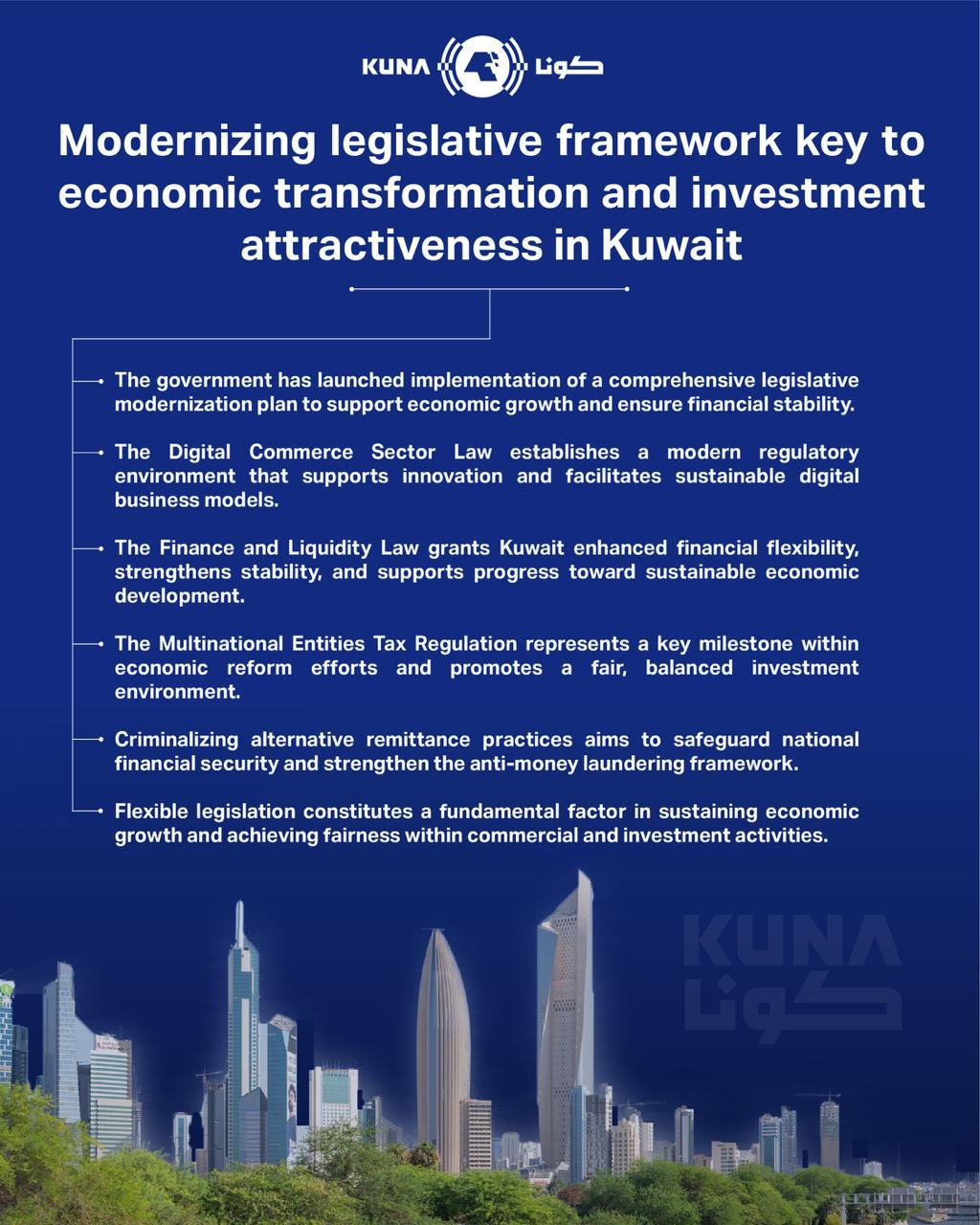
KUWAIT, Jan 4 (KUNA) -- Kuwait's institutional economic transformation is anchored in several pillars, foremost among them updating the legislative framework amid rapid global challenges, evolving production and investment patterns, shifting towards digital economy, and intensifying regional competition for capital.
In this context, the national plan to modernize Kuwait's legislative framework has gained prominence, with the government advancing it as a structural reform tool aimed at aligning the legal environment with global sustainable development goals for 2030 and Kuwait Vision 2035.
As a key step to support innovation and entrepreneurship, the cabinet approved in November a draft law regulating digital commerce, establishing a modern and enabling environment for digital business models and introducing regulatory sandboxes allowing innovators to safely test products and services before commercialization.
The draft law sets an integrated protection framework covering privacy safeguards, clarity of terms and conditions, and effective dispute resolution mechanisms, thereby strengthening confidence in electronic transactions and promoting a safer, more transparent digital trade sector.
This legislation represents a milestone in updating Kuwait's legal framework, providing comprehensive regulation for digital commerce while balancing economic freedom with regulatory oversight, enhancing investment attractiveness in the digital economy, and supporting sustainable development objectives.
In efforts to reinforce financial stability and support economic growth aligned with Kuwait Vision 2035, Decree-Law 60 of 2025 on financing and liquidity was issued in March, setting a public debt ceiling of KD 30 billion or its equivalent in major convertible currencies.
The decree allows issuance of financial instruments with maturities of up to 50 years and remains valid for 50 years, granting Kuwait greater fiscal flexibility to access local and international markets and improve liquidity management, according to the then Minister of Finance and Minister of State for Economic Affairs and Investment.
The law marks an important step in fiscal and economic reforms aimed at building a more diversified and sustainable economy that serves the interests of both the state and citizens.
To enhance transparency in real estate transactions, Minister of Justice Counselor Nasser Al-Sumait issued Decision 194 of 2025 regulating payment of values and cash considerations in all official deeds, contracts, debt acknowledgments, and mortgages issued by the Ministry of Justice.
The decision requires proof of payment through bank transfers or certified checks, supporting anti-money laundering efforts, limiting fictitious mortgages and debt acknowledgments, and closing legal loopholes previously exploited for unlawful transactions.
It also protects the real estate market from financial manipulation, enhances transparency, safeguards buyers and sellers from fraud and sham sales, and strengthens financial oversight to prevent money laundering through property transactions.
In August, Decree Law 89 of 2025 amending certain provisions of Law 118 of 2023 on establishing and developing residential cities or areas economically, known as the real estate developer law, entered into force.
The amendments granted developers greater flexibility to offer diverse housing products tailored to varying family needs, capacities, and unit sizes, supporting market responsiveness and housing supply diversity.
In a major step toward economic reform, fair investment conditions, and tax equity, the Ministry of Finance issued in January 2025 the executive regulations for the decree law on the tax on multinational enterprise groups.
The regulations clarify legal provisions, define procedures and implementation mechanisms, enhance transparency, and provide clear guidance to stakeholders in line with international standards, reflecting Kuwait's commitment to fiscal balance and revenue diversification beyond oil.
Preliminary estimates indicate annual revenues from the tax could reach approximately KD 250 million, strengthening the state's capacity to build a resilient and sustainable economy capable of addressing future challenges.
To safeguard financial security and strengthen anti-money laundering efforts, the cabinet approved in December 2025 a draft decree law adding Article 12 bis to Law 111 of 2013 on commercial shop licensing.
The amendment criminalizes alternative remittance systems, considered among the most dangerous illegal financial practices and a serious threat to Kuwait's financial and economic security.
Two Kuwaiti specialists in administrative sciences and economics told KUNA that legislation is not merely a regulatory framework but a decisive factor shaping the investment climate and guiding economic behavior.
They stressed that the quality and flexibility of laws are directly linked to growth rates, efficient resource allocation, and the economy's ability to diversify.
Dean of the College of Administrative Sciences at Kuwait University Dr. Ali Al-Mutairi said reviewing all existing legislation aims to create a modern legal environment aligned with comprehensive development requirements.
He added that updating legislation strengthens transparency and accountability in government institutions, achieves social justice and equality before the law, and ensures sustainable stability.
Al-Mutairi explained that academic aspirations focus on coordinating legal and economic dimensions through new economic laws supporting sustainable growth, particularly in investment, trade, taxation, labor, and small and medium enterprises.
Such reforms, he said, reduce legal and procedural risks for investors, enhance entrepreneurship and innovation, improve market efficiency through fair competition, and curb monopolistic practices.
He noted that academic studies in law and economics emphasize the urgent need for continuous updates to economic legislation to respond to digital transformation and economic globalization.
Al-Mutairi considered legislative amendments a key driver of economic cycles, positively impacting growth rates, job creation, and productivity.
Meanwhile, Vice Chairman of the Kuwait Economic Society Ahmad Al-Tuhaih underscored the importance of updating the legislative structure to keep pace with global economic developments.
From an economic perspective, Al-Tuhaih described the government's approach as signaling a new phase of institutional reform aligned with global developments and Kuwait's development vision.
He noted that balancing social, criminal, and economic pillars reflects a comprehensive development vision recognizing that economic reform cannot succeed without parallel social and judicial reforms ensuring justice and stability.
Regarding recent updates to the bankruptcy law, including reinstating arrest and detention measures for willful default, he said these changes translate the Ministry of Justice's efforts under the approved plan.
He expressed hope for further economic legislation, notably the establishment of an economic court in Kuwait.
Al-Tuhaih stressed that the economic dimension of the national legislative update plan should mark a genuine turning point in restructuring Kuwait's business and investment environment.
He expected reviews to cover pivotal laws, including the Commercial Companies Law, the Direct Investment Promotion Law, and the Public-Private Partnership Law, which form the backbone of Kuwait's business environment.
He emphasized simplifying procedures, expanding governance and transparency, updating competition and anti-monopoly laws, and aligning labor market legislation with market needs.
Updating tax and financial systems, he added, should secure sustainable revenues without undermining economic attractiveness.
Al-Tuhaih conclu