LOC11:49
08:49 GMT
News report
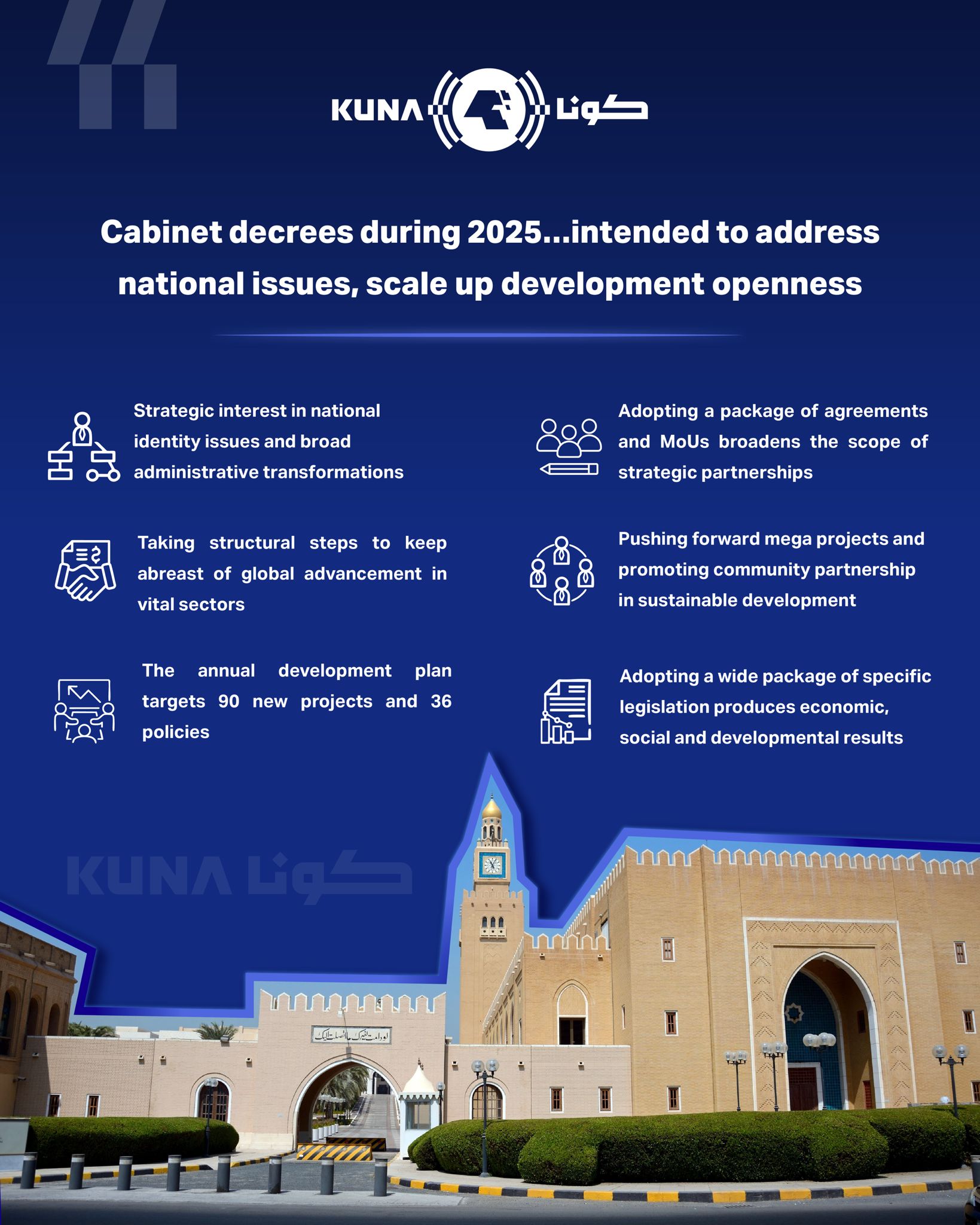
KUWAIT, Dec 25 (KUNA) -- The Kuwaiti government has scaled up its efforts and measures this year by adopting more than one hundred decrees purposed to address national issues, usher in a fresh phase of radical and structural reforms, sustainable economic transformation, augment developmental openness, and broaden the scope of strategic partnerships.
The legislative pillar came as a core aspect of the government agenda priorities throughout the year by means of deciding a package of draft decree-laws as a multifaceted development catalyst for both economic and social landscapes in line with the goals of the sustainable national vision.
For instance, broad amendments have been introduced to the penal code, laws of criminal procedures and trials, civil and commercial pleadings, and court fees, the Expert Law, the provisions of the Kuwait Anti-Corruption Authority (Nazaha) Law, and the laws of registration and electronic transactions.
The legislative amendments in question featured a set of economic laws involving a financing and liquidity decree-law, an amendment to the bankruptcy law, a digital trade decree-law, marking an integrated legal framework that regulates the digital trade sector and creates some equilibrium between economic freedom and regulatory control.
Also involved are social and humanitarian laws and amendments to laws on public assistance and children's rights as well as a new law on the protection of missing persons.
Regarding anti-crime measures, the Cabinet approved vital pieces of legislation, including ones pertinent to fighting drugs and psychotropic substances as well international crimes, along with international judicial cooperation.
Furthermore, the Cabinet sought to keep abreast of global advancement in several vital sectors through structural steps and fresh laws, including the Civil Aviation Law, which is considered one of the basic requirements of the International Civil Aviation Organization (ICAO) and the main determinant of airport and air navigation service facility licenses, along with the law scrapping the Public Authority for Roads and Land Transport (PART).
A draft decree was also made for a unified registration and admission system for all military and security institutions.
The government decrees adopted throughout 2025 have reflected a growing strategic orientation towards the promotion of the national identity and citizenship issues, along with the consolidation of administrative regulations as the cabinet adopted a package of minutes of the high-level citizenship committee and set up a relevant grievance panel.
However, government orientations did not shrug off "humanizing procedures" since multiple facilities were extended to the groups affected by citizenship revocation decrees, particularly those who had acquired Kuwaiti citizenship thanks to their praiseworthy achievements, as well as foreign wives of Kuwaitis.
In the context of safeguarding individualsآ’ and businessesآ’ financial stability and legal standing, the decrees embraced a series of facilitations, primarily the continuation of the right to trade, buy and sell shares, bonds, and securities on the stock exchange or securities market for individuals and companies owned by persons whose citizenship has been scrapped.
They have also been given access to the same benefits and rewards of small and medium-sized enterprises pursuant to Law 98/2013 and its amendments.
Socially, the Cabinet decided to approve the proposals of the Public Authority for Housing Welfare allowing those with revoked nationalities to retain some rights and privileges.
As for the development and economic pillar, Kuwait and China signed an engineering, procurement and construction (EPC) contract for the Mubarak Al-Kabeer Port project on Bubiyan Island.
Furthermore, the cabinet approved the 2025-2026 annual development plan involving nine programs, 134 projects, 36 targeted policies and 38 legislative requirements, in addition to the 2025-2026 draft state budget including 90 new projects.
Throughout the year, the government adopted several administrative and regulatory decrees, forming the six governoratesآ’ councils and promoting members of the Fatwa and Legislation Department.
The Cabinetآ’s measures also included the creation of ad hoc committees and taskforces to look into remarks and violations mentioned in state audit and control agenciesآ’ reports.
To beef up community partnership and strengthen sustainable development, the decisions reflected great interest in the issue of donations and community work, with a large package of donations having been approved, mainly targeting broad support for the health sector.
Externally, the State of Kuwait has boosted its foreign diplomatic influence by means of hammering out dozens of agreements and memoranda of understanding during 2025 in a move that reflects a growing ambition to widen the network of strategic partnerships with sisterly and friendly countries, and to bolster international openness just as a core pillar of backing national development blueprints and promoting Kuwait Vision 2035. (end)
star.mt